The Silence of a Father in Bunia
“That night, he did not fear death. He feared that, before he departed, he would not manage to save what was most precious to him in the world: his two young children.”
There are people whose names will never be written in the books of history. They will not be awarded honors, nor will their names be heard in official ceremonies. Yet, it is often upon their shoulders that humanity itself rests. For it is upon these “superhumans” that history is written, and not upon the complacent backs of certain celebrities. They are the unsung heroes of everyday life; the fathers and mothers who silently sacrifice their lives, their desires, and even their very existence, so that their children may behold a better tomorrow.
He was one of them.
A father of two boys. A simple man, without extensive education, but with wisdom born from pain. Life was his only school. Poverty became the teacher of his patience, difficulties taught him perseverance, and countless trials taught him that love is not an emotion, but a daily sacrifice and reality.
His health began to falter. Those around him urged him to seek immediate medical care. But he remained silent. He was not only considering his own pain. He was considering the cost of hospitalization, the future of his children, the bread that would be missing from their table, the dreams that might remain unfulfilled. In places where poverty is a daily companion, even illness transforms into a harsh financial ordeal.
His wife stood by his side.
Few words were needed between them. Their gazes had learned to converse even before words were born. Together, they bore a cross they had not chosen. Every day, they calculated their meager funds, their children’s food, their school expenses, the next day. Every small decision concealed a great sacrifice.
The father did not dream of riches.
He dreamed of seeing his children educated. Of them leaving, if necessary, far from violence and misery. Of them acquiring the opportunities he himself never knew. Of them becoming people of faith, dignity, and love for their fellow human beings.
Because true parents measure their success not by what they left in the bank, but by what they etched into the hearts of their children.
The story of this family is not unique.
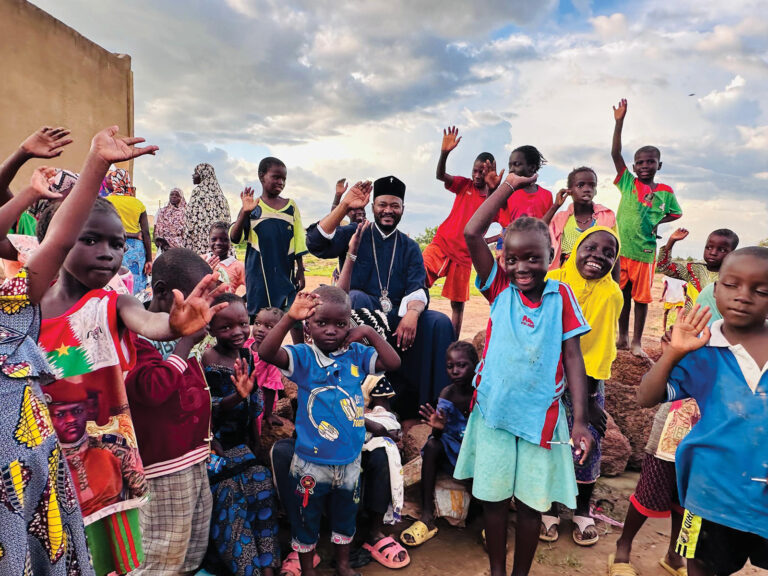
It is the story of thousands of families in eastern Congo, and particularly in the long-suffering province of Ituri. There, armed conflicts, population displacements, poverty, lack of medical care, and insecurity turn every day into an unrelenting struggle for survival. Parents do not only fight to live; they fight to ensure that their children will have hope for tomorrow.
And yet, even amidst this trial, life does not cease.
Children continue to laugh. Mothers continue to pray. Fathers continue to work, even when their bodies are bent with exhaustion. And our Church remains there, often as the sole safe refuge. With humility, it serves the sick, supports orphans, cares for the weak, and keeps the flame of hope burning brightly in the hearts of people.
No one knew the whole truth about this father.
He did not distance himself from his children because he stopped loving them. He distanced himself because he loved them more than his own life.
His symptoms clearly indicated what he had contracted; the Ebola virus was already ravaging his insides.
At that moment, he understood that his greatest battle was no longer to save himself. It was to protect those who constituted his entire world. He knew that every touch, every embrace, every kiss could cause both of his children to be lost.
And then he made the most difficult decision of his life.
He voluntarily isolated himself.
He deprived himself of their voices, their laughter, their embrace. He remained alone, not because he feared death, but because he refused to let death approach his children. It was a silent sacrifice, unknown to many, but known to God. He stood by his children until the end to experience them, but at the same time, isolated from them to save them.
Until his last breath, he prayed not for his own days to be prolonged, but for the days of his children to be prolonged. He left them neither wealth nor possessions. He left them a legacy that time cannot diminish: faith, dignity, and the example of absolute love.
A few days later, he peacefully closed his eyes.
He was not defeated.
Because there are people who do not win by prolonging their own lives, but by offering their lives so that others may live. This is indeed a great victory.
His story is one more, among thousands of similar stories in eastern Congo. The Ituri province continues to bleed from conflicts, destitution, insecurity, and now also from the deadly Ebola epidemic. Prospects for many people remain limited. And yet, amidst the ruins of war, hope continues to blossom. The Church continues to stand by the people, to care for the wounded, to protect children, to support families, and to bear witness that love can survive even where all seems lost.
One day, the wars will end. The epidemics will pass. The wounds will heal. The churches will once again be filled with children’s voices, and people will rebuild their homes and their lives.
Perhaps then no one will remember the name of this father.
But God will remember his sacrifice.
And perhaps this is the greatest vindication for a man who loved his children more than himself.
P.S. We kindly ask all who are able to support our efforts in organizing regular meals for our needy children and for their healthcare. A few euros save their lives.
Warm thanks to the Orthodox Missionary Fraternity for their tireless and unwavering support and assistance in our humble work.
† Polycarpos of Bunia and Kisangani
Αυτή η σελίδα είναι διαθέσιμη και στα