How Saint Chrysostomos Began His Missionary Journey on the African Continent
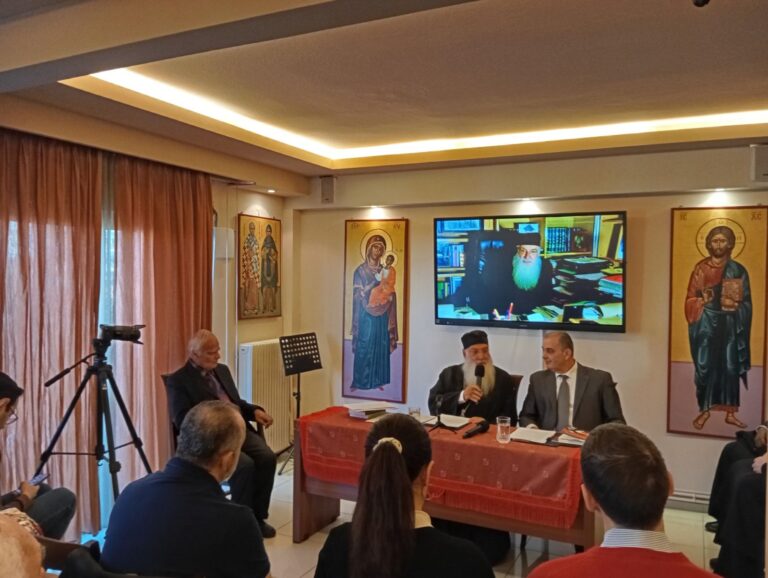
Excerpt from the Fraternity’s event “A Sanctified Journey in Africa” at the Aristotle University of Thessaloniki Ceremony Hall (December 2019)
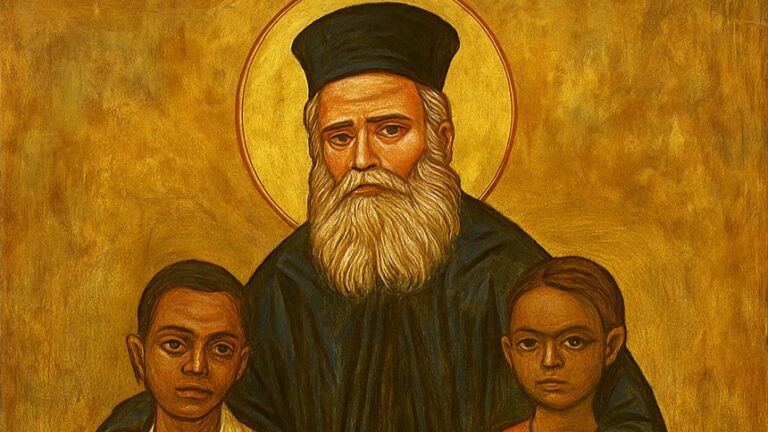
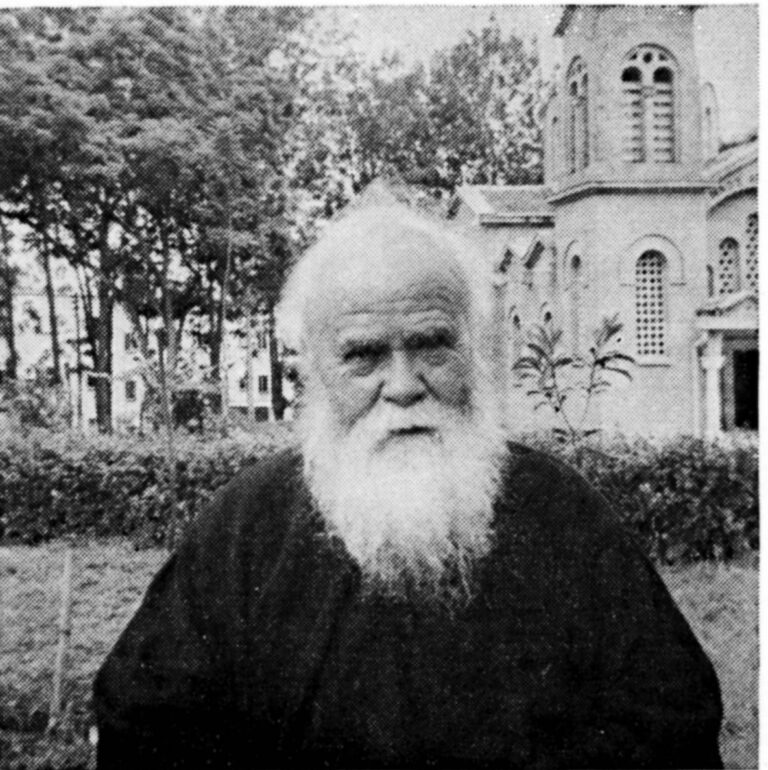
For historical reasons and to be precise, it would be good to follow Father Chrysostomos Papasarantopoulos’s preparation for his great and unknown journey to the Dark Continent. For this reason, we will let him open his heart to us, hear its pulsations, and speak to us through his own writings and various thoughts about the preparation for this adventurous journey to East Africa.
I believe his thoughts are moving, as it truly becomes apparent with how much desire and love he wanted to work in the African Continent, even though he suffered physically, being of advanced age. As described in his diary, there were many days when he felt great discomfort. And yet he did not say: “Let me stay here somewhere to rest. Why do I want to go to Africa?”
He had made up his mind and absolutely had to go to East Africa, where he had dreamed of going. Let us allow Father Chrysostomos to tell us some of the thoughts and ideas that God, I believe, enlightened him to write then about his journey in East Africa. We are in the year 1960, when Father Chrysostomos had already made the decision for the great journey of his life.
Preparation in the Holy Land
A journey that opened new horizons for him and revealed a new chapter in the course of his earthly life. This unknown journey was meant to be directly related to the person of Jesus. Where He was born, baptized, preached, performed miracles, was crucified, and finally resurrected.
So he arrived in the Holy Land. Through his diary entries, Father Chrysostomos describes the various services and the most significant places he had the opportunity to visit. He describes in detail the people he met, hierarchs and priests, as well as the then Patriarch of Jerusalem, Benedict.
His participation in the services was something that deeply moved him. Because by taking part in the Holy Services, his mind, soul, and heart were focused on his destination. That which he had already set his mind on: to proceed to the then-unknown African Continent and become the pioneer.
He who would strive under difficult and adverse conditions to offer, as a true warrior of Christ, a small, minimal gift of gratitude to the Lord Himself for the divine blessings in his life until then. Father Chrysostomos wanted, during those days he was in the Holy Land, to fully prepare himself and to see that his visions could finally find, through a miracle alone, their fulfillment. Thus, he prayed with all the strength of his heart to be able to walk upright and an unshaken rock through the flame that burned his soul, remembering a beautiful saying: “there are some ideas that always find us young and keep us young.” Such an idea is the ether of eternal beauty, which fills the universe.
Father Chrysostomos, to complete these thoughts, adds that the universe, that is, creation, incorporates and embodies the most beautiful element of nature, which is man, man everywhere on earth. This man, at that moment in Jerusalem, he was preparing to embrace and give spiritual and divine content to. That which would make Africans, through their purity and faith, understand that they too participate and can acquire spiritual greatness and see the heavenly unite with the earthly, thus leading them in the end, through disappointments, ignorance, and storms, to the splendor of the Resurrection.
There, kneeling at the Holy Sepulchre, he envisions a profound re-baptism through his faith and devotion to the towering peaks of immortal victory. He wept rivers of tears, praying to remain devoted to his crazy, as he called it, and extreme decision to go among them and struggle with them. On April 24, 1960, as he notes in his diary, he arrived at the port of Alexandria and conclusively writes his first thoughts:
“I returned to my room and sat until ten at night. May the Lord be glorified for deeming me worthy to set foot on this dark continent. May His grace prosper so that I may reach my destination and successfully accomplish my mission for the glory of His Holy Name and His Church, for the salvation of many souls, for whom He sacrificed Himself on the Cross.”
First Thoughts and Trials
The very next day, he had a meeting with the then Patriarch of Alexandria, Christopher, with whom he discussed his desire to go to Africa to voluntarily and experimentally undertake this wonderful work of Evangelism. He characteristically confesses:
“I am not worthy of anything, but may the work of Christ and His Church prosper. Lord Jesus Christ, for Your Holy Name I left my beloved Homeland and all my comforts therein. I was separated from my dearest brethren in You there and came here. Do with me what You will and as You will, that Your Most Holy Will may be done in all things.”
The way was already open for his fervent and deep desire. During his stay in Egypt, he met not only the Patriarch but also other hierarchs and clergy who served at the Patriarchate of Alexandria at that time.
There were also moments when Satan wanted to test his patience and faith. However, nothing could shake him or change his already made decision to go to the nations. This is clearly evident in his following thoughts:
“May 3, 1960. The climate of Alexandria is heavy. My case is stagnant, but I await the Lord’s salvation. Moments of cowardice come, but the grace of Jesus drives them away.” And he adds: “By sight and hearing, the righteous and the first attack. Lord, quickly crush Satan underfoot. Or should we call this the first abandonment, but I am not alone.”
He continues the next day:
“What have I offered to my Lord all these years? If I put it down, I think I will find a great deal of liabilities. And what if we attribute my assets to the Lord? Bless, O Lord, my short life that You have still appointed us to be fruitful on this earth. Grant, O Christ, that we may do something before we become timid.”
Arrival in Africa
Thus, everything proceeded smoothly until that moment. The preparations were completed. With the consent of the Patriarch and a letter from the then Metropolitan of Irenopolis, Mr. Nicholas, the later Patriarch of Alexandria, the now aged eagle of the Mission, on May 23, takes flight.
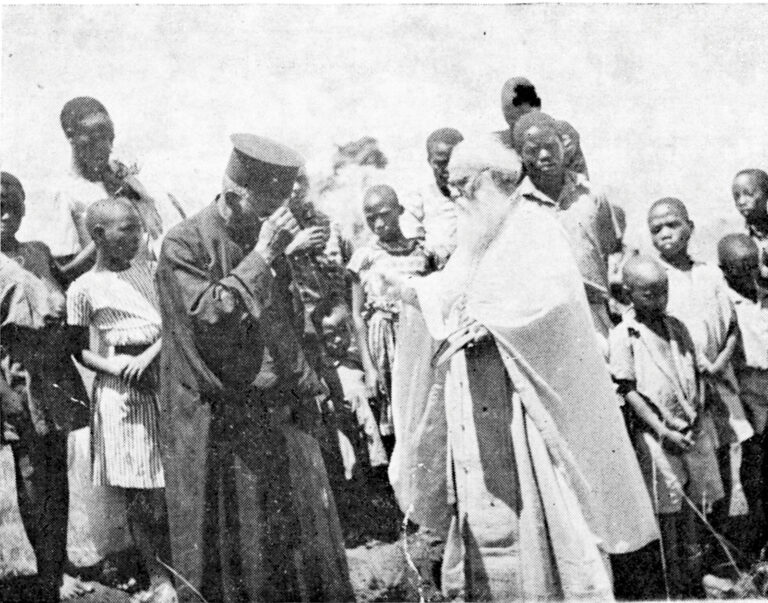
He spreads his wings and arrives where his desire is fulfilled. He finally sets foot on the sanctified and blessed lands of Africa. He travels by road from Ethiopia to Uganda, where the center of the Mission of the Metropolis of Kenya was then located.
Due to lack of space, we will not add his impressions from this distant journey, where he vividly describes the beautiful nature of Africa and its people.
“Blessed and glorified be the Name of the Lord unto all ages. Whatever I may say, whatever I may write, it will be nothing for His glory and for the expression of my feelings. Indeed, great emotions are expressed only through silence.”
He wrote in his diary.
Here we should mention that the then Metropolitan of Irenopolis, Nicholas, had, in early 1960, asked the then pioneer Father Rouvim Moukasa-Sparta to write a letter to Father Chrysostomos Papasarantopoulos, who was already anxious to reach the African Continent.
My Personal Relationship with Father Chrysostomos
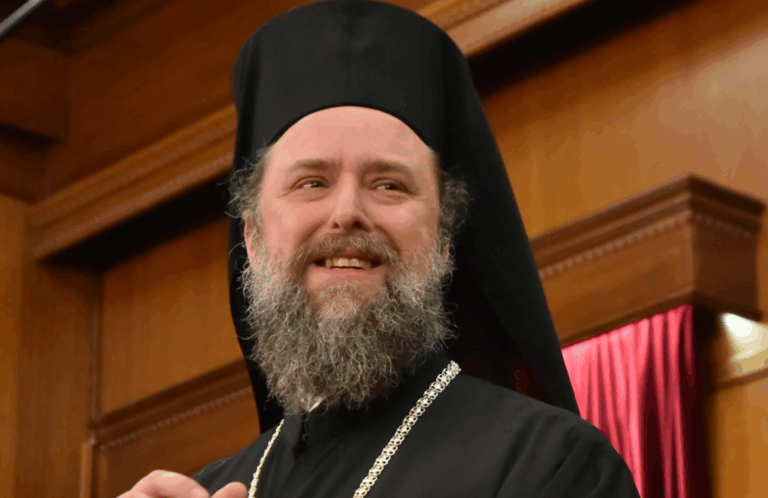
For many decades I have been involved with the life and work of the late pioneer Missionary, Father Chrysostomos Papasarantopoulos. I did not have the blessing to know him personally. However, I believe that Divine Providence, in another way, brought him into the course of my life.
Even when I was a teenager, in Sunday schools and groups, when I was just fifteen years old, they spoke to us about Orthodox Missions. Father Chrysostomos was a classmate of young Cypriot deacons and clergy at the time, as well as with the first Orthodox African Theologian, Father Theodore Nagiama, the later Bishop of Naucratis and finally the first Metropolitan of Uganda.
These frequent references to Orthodox Missions in Sunday schools inspired us all. They gave us wings, and so, as teenagers, we began to dream that one day we would fly and go to Africa as missionaries. However much this was, in a way, enthusiastic youthful fervor, in the end it seems that Divine Providence acted and guided our steps to this beloved place called Africa, and particularly to East Africa.
Among the various events that we all worked on as students to promote the work of Orthodox Missions in East Africa, was the fundraising to build the first missionary center in Kampala, Uganda. At that time, some money was collected and sent through the then Protosyncellus Archieratical Commissioner of the then Holy Metropolis of Kition, Archimandrite Aimilianos Nikolaou Sideras, who was a classmate and friend of Father Chrysostomos.
Father Nicholas then invited Father Theodore Nagiama, also a young classmate of his, to visit us in Cyprus and tell us about the work being done in East Africa. Indeed, Father Theodore Nagiama came to our island and spoke in detail about the missionary work in East Africa in Sunday schools and groups, as well as in his sermons in various churches in the city of Limassol.
I remember then that I personally missed almost none of his speeches. I would cycle around and go to the churches and places where Father Theodore Nagiama would speak about Orthodox Missions, especially about the work being done in East Africa, and I would listen to him speak with great zeal about the late Father Chrysostomos.
I remember him emphasizing it, because he himself believed that the presence of Greek missionaries in East Africa was essential. So, moved by enthusiasm, I asked him to give me the address and the exact name of Father Chrysostomos, this Greek missionary unknown to me in East Africa. I took it and without losing time, I wrote him my first letter, which dates, based on his letters and copies of my own letters that I possess, shortly after his arrival in Africa, in 1961.
I then wrote the letters I sent him in a large notebook for archival purposes. I wonder myself how the idea came to me at 15 years old to keep an archive of the letters I wrote. Like him, I also had a great fondness for correspondence. I would write, and Father Chrysostomos would reply. I would write to him again, and he would reply again. Our correspondence lasted until the eve of his death.
Suffice it to say that his last letter to me was written when he was already in Zaire, three days before his death. Father Chrysostomos was looking for assistants. Searching through my archive, I found these letters.
By way of example, I quote verbatim his first letter to me dated September 20, 1961. For reasons of time, I will not read the entire letter. His biography is mentioned here with information about who he is, where he comes from, when he was born, and what he has done in his life. It is a kind of autobiography. But the most important part of the letter, the first letter Father Chrysostomos wrote to me, is the last paragraph:
“So, my beloved Andreas, go forth with the grace and help of our Christ. If the Lord allows me to work for 8-10 years, I will be happy to hand over to you, Andreas Tyliridis from Limassol, Cyprus, the continuation of the sacred work. Many blessings to all Christian children and good children of Limassol and to the whole world to be enlightened.”
“With the love of our Christ, Archimandrite Chrysostomos Papasarantopoulos.”
And here tonight, Elder Amphilochios is a witness, with whom I walked, when he was a young Archimandrite and I a layman, to the places where Father Chrysostomos Papasarantopoulos truly sowed. So Father Chrysostomos wrote:
“Therefore, from this distant land, I greet my old chosen friends in Thessaloniki and earnestly ask them to pray and intercede that the Lord may enlighten and strengthen me to work a little for His glory and His Church. Here where I came, I obey His secret command.”
The then Metropolitan of Irenopolis, Nicholas, was very pleased and appointed him General Secretary of the Mission.
“The Orthodox Mission of our Church is now a reality. All devout Greeks must take an interest and contribute. Africans are continuously converting to Orthodoxy, and it is the greatest opportunity for action.”
Succession and Acquisition of the Archive
Our correspondence continued even after my departure from Cyprus, as after completing my military service in 1966, I left to study music in England. We continued our correspondence not only then but also when I completed my theological studies in Paris and arrived in Oxford for my doctorate. Through these letters, Father Chrysostomos’s foresight, perhaps even clairvoyance, is evident, that one day I would be able to help and continue his missionary work.
How else can one explain the words he wrote to me when I had just turned 16, I, an obscure and poor high school student then, that I would succeed him in this very important work which he himself was performing? Many years later, during a visit to Kenya by the late Metropolitan Nektarios of Leros, Kalymnos, and Astypalaia, who was one of the first collaborating clergy to have followed him years ago to Zaire, he asked me to take him to see the places where Father Chrysostomos lived and worked.
That visit by the late Metropolitan Nektarios was the occasion for me to have today the personal archive and diary notes of Father Chrysostomos Papasarantopoulos. Because when he saw the places where Father Chrysostomos lived, he invited me to Kalymnos to give me this archive, which was entrusted to him by Sister Olga Papasarantopoulou. At the first opportunity, I arrived in Kalymnos. The late Metropolitan Nektarios gave me the freedom to search and study the various archives, books, and other items and to choose whatever I wanted that concerned Father Chrysostomos, because he believed that I would make good use of it.
So, with great joy, I took whatever I could from the archive: letters and personal documents concerning Father Chrysostomos Papasarantopoulos, as well as his diary notes which he began in Greece and continued to Jerusalem, and how he subsequently arrived in Alexandria, met Patriarch Christopher, and all the agreements and arrangements were made there for him to proceed to East Africa.
Recognition and Cooperation
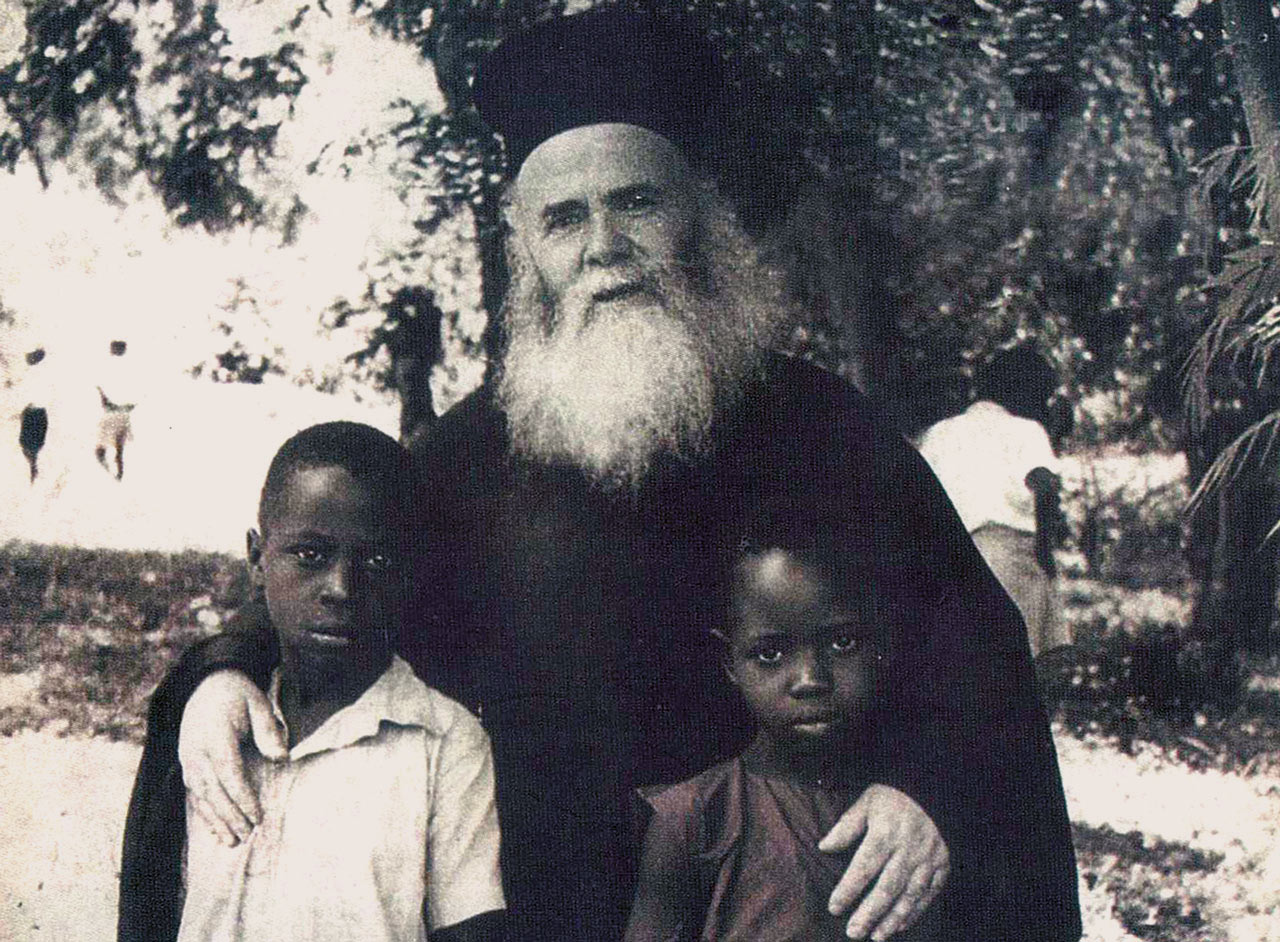
Father Chrysostomos certainly belongs to the category of clergy who had never thought of doing anything for themselves. He sacrificed his entire life, and despite his old age and illnesses, he sought to leave for distant, unknown Africa. He remained steadfast there, and when he was once forced to change location, he did not think of returning to Greece, but asked the Patriarch of Alexandria to allow him to continue his work in Africa. Furthermore, he was the first to support the first Metropolitan of Kenya and Irenopolis, Nicholas, the later Patriarch of Alexandria Nicholas VI, who even sent him a letter giving him the following instructions to continue the work he undertook then in East Africa, thus recognizing his great contribution to the spread of Orthodoxy on the African continent.
“Having in mind the invaluable services rendered to us by your beloved Panosiologiotatos, the Mother Church and the God-saved Metropolis, we appoint him our general Archieratical Commissioner with broad jurisdiction and with the right to represent us in every ecclesiastical and administrative event, to sign on our behalf the certificates and other documents concerning the Holy Metropolis of Irenopolis during our absence therefrom.”
Many are the incidents that connected the life of Father Papasarantopoulos with various places and personalities. Noteworthy was his acquaintance then with the late Archbishop Makarios III of Cyprus, whom he met during his visits in 1970 to East Africa and particularly in Kenya, during the Archbishop’s first contact with Africans, when he cheered and worked to help promote the evangelistic work among the friends of East Africa.
With great humility, Father Chrysostomos, who had already left for Zaire, wrote to the Chorepiscopus of Constantia, the later Archbishop Chrysostomos I of Cyprus, who was an assistant:
“Firstly, I wish to express my great joy for all that was accomplished in Kenya with the presence there last March of His Beatitude Archbishop Makarios. Blessed be the Name of the Lord, who by His grace gave that great spiritual satisfaction to the heroic representative of Christian Orthodoxy and of Greek Valor and Magnanimity.”
Testimonies of Others about His Work
Before we conclude, it would be beneficial to present, from among hundreds of letters received by Father Chrysostomos Papasarantopoulos from friends and supporters of his work, a text from the late Elder Philotheos Zervakos, who is known as a saintly figure of the 20th century.
So Father Philotheos writes in 1962:
“Firstly, you will allow me to congratulate you for the zeal, the eagerness, the love, and the brotherly affection which I see you have and show towards the African brethren in Uganda. It is not from us, but a gift of God, because every good gift and every perfect gift is from above, coming down from the Father of lights. Secondly, as an elder with experience, I advise you to work and toil for the love of the brethren and furthermore to compel yourself according to the God-preaching Apostle Paul. To toil, but also with discernment. “For discernment is greater than all virtues.”
The late academician Ioannis Karmiris, then also Father Chrysostomos’s professor, notes the following in one of his letters:
“I earnestly desire to express to you my sincere congratulations and to wish that the Lord may always strengthen you for the continuation and progress of the work begun, which will be included with your name and those of your other collaborators. For example, my student Father Theodore Nagiama in the annals of the history of Orthodox Mission in Africa.”
Among the various remnants of Father Chrysostomos, many of his personal notes were found, and I hope they will be published in a future work of mine. Today, however, tonight, I content myself with making public handwritten verses by an unknown author without any commentary.
Hymnographic Texts
Apolytikion of the Holy Father Chrysostomos, Equal to the Apostles in Africa
Quickly anticipate.
Faithfully following the path of the Apostles, and reaching the ends of Africa with God, O Father Chrysostomos, whence you were revealed in the last times, a divine Apostle and preacher of the faith, for which you intercede with the Lord.
Megalynarion
Rejoice, in the last times and seasons, new Apostle, bringing the Gospel of Christ to Africa, through myriad dangers, and serving Christ, Father Chrysostomos.
Learn more about the pioneer missionary Fr. Chrysostomos Papasarantopoulos
Αυτή η σελίδα είναι διαθέσιμη και στα