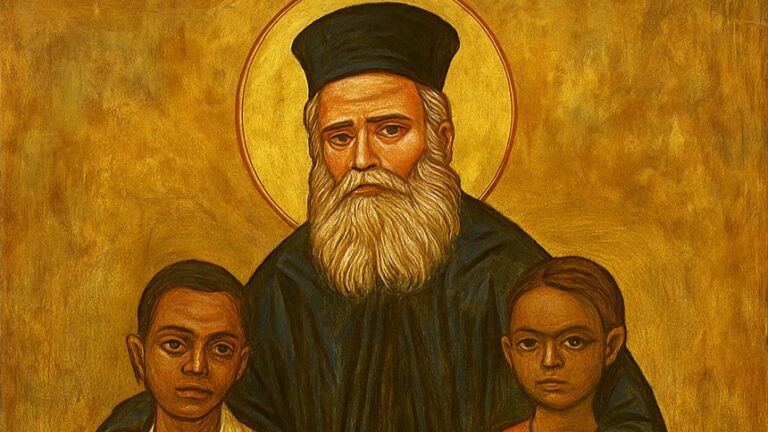
Saint Chrysostomos Papasarantopoulos: The First Missionary of Congo and His Sacrifice
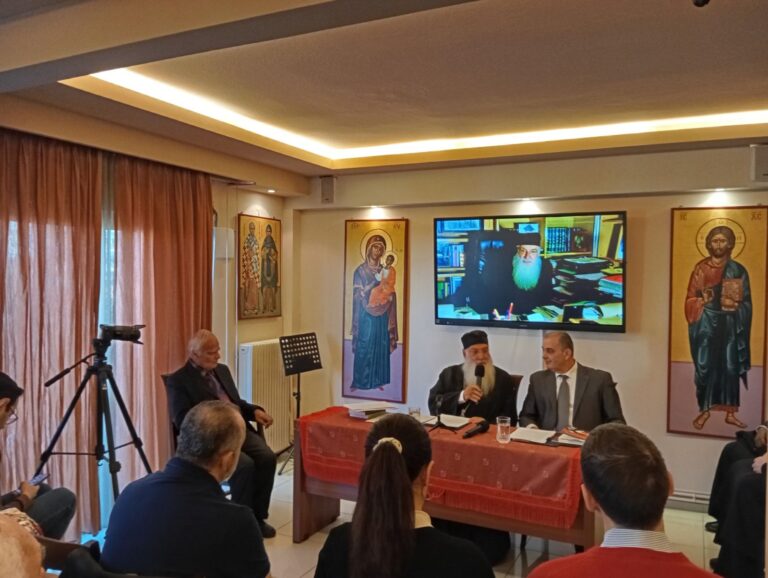
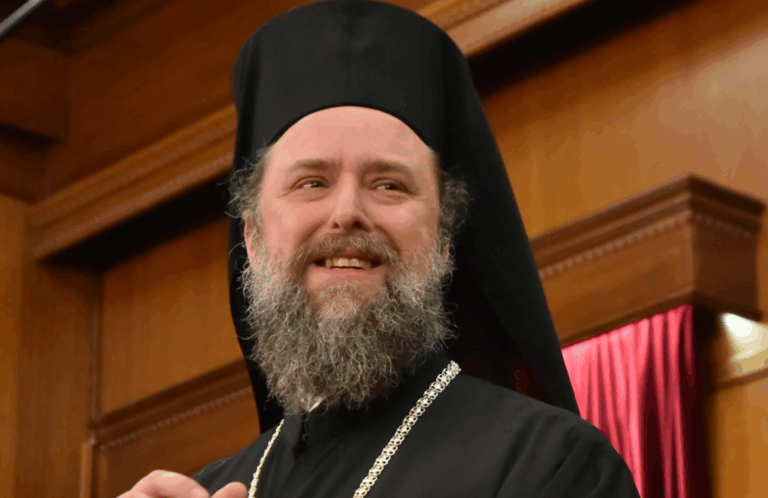
Excerpt from the Fraternity’s event “A Sanctified Journey in Africa” at the Aristotle University of Thessaloniki Ceremony Hall (December 2019)
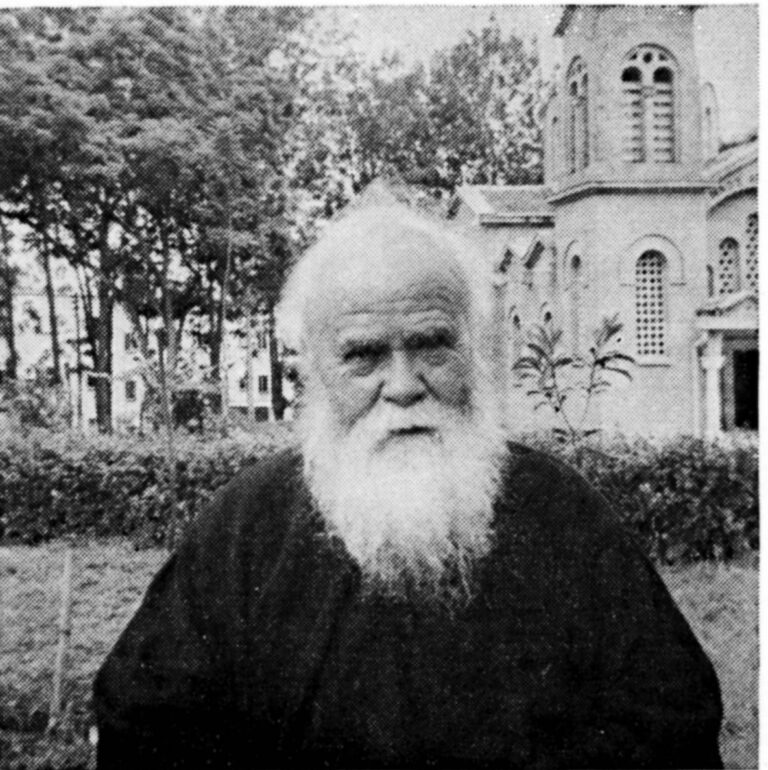
The contribution of Father Chrysostomos Papasarantopoulos to the missionary effort of the Patriarchate of Alexandria and All Africa, as well as of all Orthodoxy, is significant. The memory of Archimandrite Chrysostomos Papasarantopoulos has been indelibly etched both in the heavenly tablets and in the hearts of devout Christians, especially our African brethren. Moreover, his name is imprinted in the hearts of all those who serve the Mission and the Evangelization of peoples across the world.
He is the founder of the Orthodox Mission in what was then Zaire, today’s Congo, about which I will speak. Kolwezi, Kasega, Kinshasa, Kananga have much to tell. He sowed the seed of Orthodoxy in East Africa and breathed his last sowing in the center of Africa, in the heart of Africa, in Kananga. Watering the soil of Africa with his sweat and blood, with his life, his example, his preaching, his letters, and his sacrifice, he laid the foundations of the Mission and became the guide for those who serve in the field of Mission.
The Vision of the Mission
He calls everyone to help. He clarifies what a missionary (ιεραπόστολος) is and what a mission supporter (ιεραποστολεύς) is. And he calls for the creation of groups in every place and city where Orthodox Christians reside, to assist the Mission.
The mission supporter is the one who, from behind the lines, supports in various ways those on the front line, who, from their limited money and time, provide the necessary resources for those serving in countries where Christ is proclaimed to struggle. These are all those, Father Chrysostomos says, who, with their prayers to the All-Good God, strengthen with heavenly wings those working in the vineyard of Christ.
“Missionaries,” Father Chrysostomos continues, “are all of you who today preach to the world that the Church is primarily Mission. Mission to ourselves so that Christ may be formed within us. Mission to people, near and far, so that the commandment may be fulfilled: love your neighbor as yourself.”
Spiritual Formation
Within Panagoulakis’ hermitage, in his cell, kneeling before his iconostasis, facing temptations and the devil, in obedience to the Abbot and the Church, he formed Christ within himself and thus first became a missionary to himself. He received the grace of the Holy Spirit, lived God’s love, and spread it to those around him, fearing nothing: neither his orphanhood, nor the difficulties of poverty and youth, nor the German occupiers in Edessa, nor the Bulgarian organization Ohrana which worked for the annexation of Macedonia to Bulgaria and terrorized the villages, nor the many dangers within the African Continent. That is why he sacrificed himself for his brethren, near and far.
Service in Edessa
The late Archimandrite Theoklitos Strangas writes about him:
“In that burning Greek region” – meaning Edessa – “I found the late Father Chrysostomos Papasarantopoulos, working with admirable activity and self-sacrificing missionary zeal. Despite the most adverse conditions, in this central part of Greek Macedonia, Father Chrysostomos toured all the suffering villages, which Ohrana terrorized. As a preacher and minister, and especially as an excellent confessor, he truly achieved remarkable accomplishments.”
When later, in 1968, the virtuous Metropolitan Panteleimon Papageorgiou of Thessaloniki, with whom he had served in Edessa, was unjustly persecuted and contrary to all notions of ecclesiastical or civil law, Father Chrysostomos hastened from Africa to support him and remind him of their common struggle in Edessa during the occupation years. It is worth reading a part of his letter:
“Easter 1968. Your Holiness, Christ is Risen! Pain and sorrow completely overwhelmed me, and I have nothing to say. Whether it is a trial or something else that the heavenly Father foresees, blessed be His Holy Name. I knew you to be endowed with considerable patience and courage when we both fought like beasts in unforgettable Edessa. I hope, with the help and grace of the Lord, that you will not lose heart now either.”
The Call to Africa
Within him, Father Chrysostomos heard the voice of God guiding him. This voice led him during the difficult years of the German occupation in Edessa. The late Metropolitan Panteleimon Papageorgiou of Thessaloniki, who had served as Metropolitan of Edessa during the occupation, recounted to me:
“While I was officiating and was in the prothesis commemorating names, I secretly heard behind me ‘and Chrysostomos the hieromonk.’ I turned and saw Father Chrysostomos. I was surprised. I asked him: ‘How did you get here? The roads are closed and dangerous.’ And he replied: ‘As soon as I learned of your election and appointment, I could not stay behind. I came to serve alongside you.’”
He had left himself in God’s hands, and God’s voice guided him. This voice led him to Africa.
“I could not do otherwise. The voice of our leader and master is imperative within me, and I had to obey, despite the protests of many dear ones. The messenger of the Lord went before me and opened all doors, so that I would not encounter any serious difficulty.”
Thus, it began.
Preparation for the Mission
He did not listen to all those who hindered him or mocked him for his decision, citing his age and health. The then Archbishop Theoklitos of Athens tried to stop him: “You are old and sick. You will die there.” And he received the answer from Father Chrysostomos: “There are graves in Africa too.”
He went to Meteora for a month. He prayed for God to enlighten him on what to do. He sought refuge in Patmos to consult Saint Amphilochios Makris. The advice of Saints comes from the Holy Spirit, because they have made their hearts a dwelling place for the Holy Spirit.
When he told him and asked for his advice, he encouraged him and said: “How I wish I could go to Africa! My old age and illness prevent me. I would be a burden and would not fulfill my duties. What a pity I grew old! I envy you, Father Chrysostomos.”
He gave him courage, and Father Chrysostomos left for Africa.
Arrival in Africa
At Easter 1960, he visited the Holy Land for pilgrimage. From there, he went to Alexandria to meet Patriarch Christophoros and receive his blessing for his decision to go to East Africa. The Patriarch gave him his blessing and, at the invitation of Mr. Soutis from Arusha, he traveled to Arusha. He stayed there for a short period and from there went to Kampala.
Missionary Activity in Congo
I will focus on his missionary activity in Congo. In 1970, he went to Egypt and met Patriarch Nicholas in Cairo, who appointed him as a preacher and itinerant spiritual father, but primarily for the work of the mission in the Holy Metropolis of Central Africa. He arrived in Kolwezi in November 1970, where he began his missionary activity.
After six months, Metropolitan Cyprianos of Central Africa sent him to Kasega, where he worked with both Greek expatriates and indigenous people. From Kananga, the indigenous people learned that the Orthodox Missionary was in Kasega. Kasega is located in the southeastern part of Congo.
And there in Kasega, committees went and asked him to come and bring Orthodoxy to them. They informed him that there were many thousands.
The Journeys to Kinshasa
He passed through Kinshasa in May 1971 for five days. Kinshasa is the capital of Congo. The Greeks asked Metropolitan Cyprianos to keep him. The Metropolitan sent him for a month in August 1971, and on September 17, he returned to Kasega.
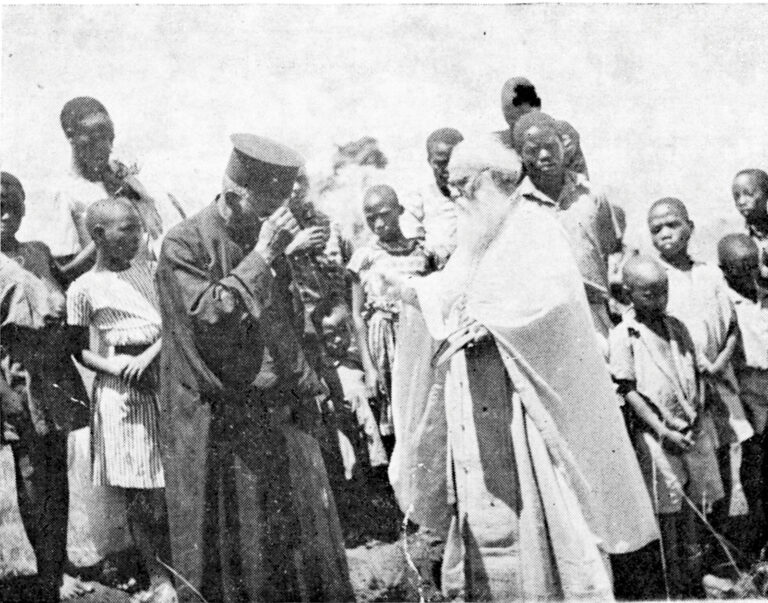
In August 1972, he was again sent by Metropolitan Cyprianos of Central Africa to Kolwezi, because the indigenous people insistently requested it. On August 7, he departed from Kasega secretly, because there were protests from the people for him not to leave, but to stay there, and he went to Kolwezi. On August 13, in a school hall, he celebrated the Divine Liturgy in Swahili.
Since then, he has celebrated it in the hall of his residence, where many come from afar, even on foot, as he writes in his letters.
The Political Context and the Sects
On December 31, 1971, the then president of Zaire – today’s Democratic Republic of Congo – by decree prohibited the operation of religious sects. These were groups with a lay leader, whom they called pastor. They gathered in a hall or a grass hut, chanted, and listened to his speech. Anyone could form such a group. However, this was uncontrolled and dangerous for state security. That is why, by his decree, he prohibited the operation of sects, as well as of Jehovah’s Witnesses.
The leaders of the sects of Kananga – Saint Peter, Heart of Jesus, Saint Sarah, and the Mysteries – learned of the existence of the Orthodox Church in the southeastern part of Zaire, knowing from history that the Orthodox Church is the oldest, and hastened with committees to meet Father Chrysostomos and beg him to come and catechize them and bring Orthodoxy to Kananga.
The Call from Kananga
Father Chrysostomos writes:
“As for me, glory to the Lord, for all things, despite my old age and fatigue, I can still do something. I give you a piece of information to rejoice, and all fathers and brethren, pray especially fervently. Committees came and came again from the interior of Congo – I am at the southern tip – and asked me to go to them and for them to collectively join Orthodoxy. I presented myself to my Metropolitan with a blessing to go everywhere. I am preparing in August to go 1,200 and more kilometers deep. Pray for me. To the most devout sisters of the Holy Monastery of Korakies, there are many, many wishes to pray for me and for our mission.”
On June 12, 1972, the “Église des mystères de Jésus-Christ” sect of Kananga requested, in a document to the Metropolitan of the Orthodox Church, that its members be catechized and join Orthodoxy. In early July, Metropolitan Cyprianos replied, asking for clarifications, and soon instructed Father Chrysostomos to go to Kananga.
Arrival in Kananga
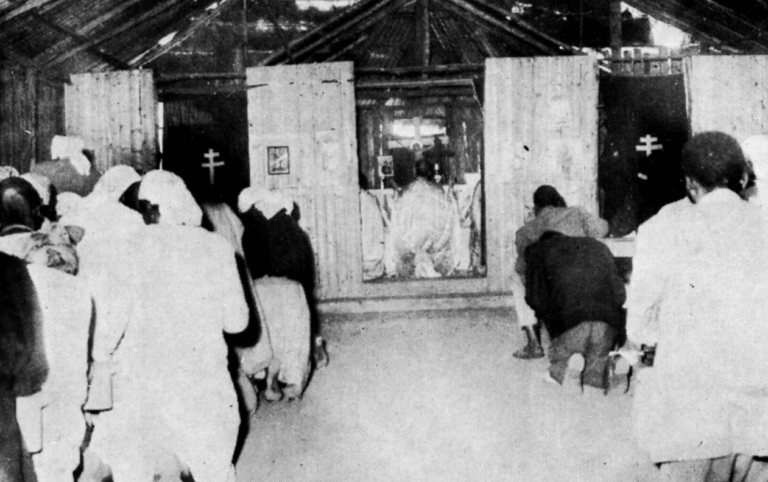
Father Chrysostomos arrived in the community of Kananga at the beginning of October 1972, accompanied by Sister Olga. On November 8, 1972, the Governor of the province signed the approval for the operation of the Orthodox Church Missionary in Kananga, and the first Divine Liturgy was held in the house where he was staying.
He then visited sect parishes in the surrounding villages, accompanied by a leader from Edmond’s sects, one of those who had invited him. He observed the people’s longing for Orthodoxy.
The First Meeting
Then immediately, as Father Achillios Bakatoufikila writes to us – who was then 13 years old and was present among the first catechumens – Father Chrysostomos called the leaders of the sects on November 20, 1972, at four o’clock, and held a meeting. The head of the provincial justice department was also present.
He spoke to them about Orthodoxy. “You sought the truth,” he told them, “and today you found it.” He was convincing, as Father Achillios tells us. His preaching was like milk and honey and so amazing that they had never heard anything like it from either Catholics or Protestants in Kananga.
At the end of this assembly, Kambé Yanoy, one of the participants, immediately declared the concession of his plot of land located on Kamwandindu Avenue for the Orthodox Church. On December 12, he performed the first baptisms and weddings.
The Last Journey
On December 13, 1972, Father Chrysostomos, accompanied by Sister Olga, departed for Mbuji-Mayi, the capital of the province of East Kasai, and from there groups had gone and asked him to bring Orthodoxy, responding to the invitation of the priest, then Father Kalala Kalonji – who had come here to Greece, was ordained and returned, but the work had not borne fruit in his administrative area of service.
Arriving at a distance of 200 kilometers from Kananga, the car carrying them got stuck in the sand due to heavy rain. While they were trying to free the car from the sand, Father Chrysostomos withdrew a few meters to rest. At one point, Sister Olga went to look for him and found him bleeding. She called for help.
Father was quickly transported to a local infirmary and, in view of the father’s health condition, the passengers were forced to return to Kananga for Father Chrysostomos to receive appropriate medical treatment in a clinic.
The Last Liturgy and Death
Father Chrysostomos’ health condition improved slightly, and so on December 25, he celebrated the Christmas Divine Liturgy in the small makeshift church on Kamwandindu Avenue, where Kambé Yanoy had donated the plot of land. However, his voice was extremely faint. He allowed the seriousness of his illness to be perceived, and when he said “Glory to You, O Lord, glory to You,” he did so, those present say, with great effort to be heard.
Sister Olga, who was also the psalmist and observed the scene, was speechless when it was time to say “Lord, have mercy,” for fear that the father might collapse in front of the people.
On Monday, December 26, in the morning, he was admitted to the Kananga clinic. On December 29, 1972, he gave up his spirit, having told Sister Olga three days earlier that something great would happen in three days.
There was no Orthodox priest to read the funeral service. What he had told everyone who urged him to return to Greece came true:
“It is better for me to die ingloriously in Africa than gloriously in my cell, in my peace. I cannot leave here, I do not want to, something holds me back.”
After His Death
A few days later, the General Archpriest, Father Emmanuel Zorbas, came from Lubumbashi and read the funeral service at his grave, saying: “My brethren, the deceased is alive. What happened was God’s will.”
Indeed, he departed as a martyr. He reminds us of his words when he wrote: “Here, some must bear witness for our mission to begin”. And this happened: he himself was the first to bear witness, he watered the African soil with his blood.
His Successors
He was succeeded in Kananga by Father Chariton Pneumatikakis, with whom he had a close spiritual friendship since both served in Edessa when Panteleimon Papageorgiou was Metropolitan of Edessa.
In Kolwezi, the then Father Amphilochios Tsoukos, later Metropolitan of New Zealand and then of Ghana and West Africa, who contributed greatly to Africa. He then brought Ioannis Aslanidis, who was a student at the Rizareios Ecclesiastical School, then inspired him and later brought Father Kosmas Grigoriatis, also a martyred Missionary. Also, Archimandrite Nektarios Hatzimichalis, the later Metropolitan of Kalymnos.
While in Mbuji-Mayi in 1974, Father Athanasios Anthidis went, who was one of his close collaborators in Kenya.
Last Letters
In one of his last letters on November 7, 1972, he writes to a student deacon, his spiritual child, who postponed his departure for Africa:
“But if you knew the dire situation I am in – old and very tired – here, you would abandon everything and even beg to find the expenses to come to me. I am now almost in the center of this immense country, and 70, perhaps even 100 thousand Africans want to enter our Orthodox Church. What am I to do first, especially being so weak amidst this multitude, and they are not all together in one parish like in Athens and Thessaloniki, but scattered over a large area.
I, of course, with the mercy and power of our Savior Christ, will strive, dedicating my last strengths to this rampart, and perhaps I will die fighting on the front line. But you, as a young man, at least undertake to tell all our students and seminarians, all our younger unmarried clergy, the following verse of the ancient Tyrtaeus to the warriors of Ancient Sparta. I read it in a modern Greek translation when I was a primary school student and I remember it:
“Shame on you, shame on you.
For the young and weak to be behind,
for the old to die in front.”
Not that I am worthy or that I offer anything. I am an insignificant and unworthy worker of the Lord. But why should many of the fervent young people who dedicate themselves to Christ, or at least some, be here. My many blessings to your fellow students and good success and progress. Your struggle is not for a small position with a poor salary but for something high and eternal.”
Epilogue
I will conclude with what his successor and close spiritual friend from the years of occupation in Edessa, the Great Missionary Archimandrite Chariton Pneumatikakis, wrote. He had written a booklet after his death, “In Africa for Christ – Archimandrite Chrysostomos Papasarantopoulos”, which was published by the Protocletos Association in 1973.
So, Father Chariton Pneumatikakis says:
“He was half a man with shattered health, a weak body, faint-voiced and slow of speech, deprived of impressive external qualities. It required immense daring to possess and an equal amount of self-denial for his audacious undertaking. He had it and he used it, which is why, divinely covered, the slow-tongued one eloquently preached the divinely written law among the black people and established himself in the Black Continent and became known as the grandfather and Saint of Africa.”
And the magazine “Our Action” of the Christian Student Action in 1973 adds:
“Now our Orthodox African brethren also have a Holy Relic. This is what those who lived with him more than anyone else, who loved him and were loved by him more than anyone else, say.”
And the late fervent theologian and preacher of the Sotir Brotherhood, Athanasios Fragkopoulos, with whom he served in Edessa under Metropolitan Panteleimon, writes:
“A multitude of angels and archangels welcomed his blessed soul into heaven to enlist him in the ranks of the great champions of faith and apostles of the Gospel.”
And the magazine “O Sotir” adds a few days after his death, January 17, 1973:
“On the day of judgment and recompense, the souls of our black brethren who were reborn by Father Chrysostomos through Holy Baptism and nourished with the bread of life and nurtured with the streams of Orthodoxy will form a brilliant crown, which will adorn him and which, together with the twenty-four elders of the Apocalypse, he will lay before Him who sits on the throne. So that he too may sit on thrones of heavenly glory and honor, clothed in white garments, thus receiving the reward of the wise stewards for all that he tirelessly served sacerdotally for forty whole years for the glory of the heavenly leader of the Orthodox Church.”
This was Father Chrysostomos.
Learn more about the pioneering missionary Fr. Chrysostomos Papasarantopoulos
Αυτή η σελίδα είναι διαθέσιμη και στα